
Most people focus on where their new hair will grow — but the hair transplant donor area deserves just as much attention. It is the strip of scalp at the back and sides of your head where healthy follicles are taken from, and what happens to it decides how natural your final result looks, both at the front and the back. In this guide, we explain what the donor area is, what happens to it during FUE, FUT and DHI, how it heals, and how to look after it.
What Is the Donor Area in a Hair Transplant?
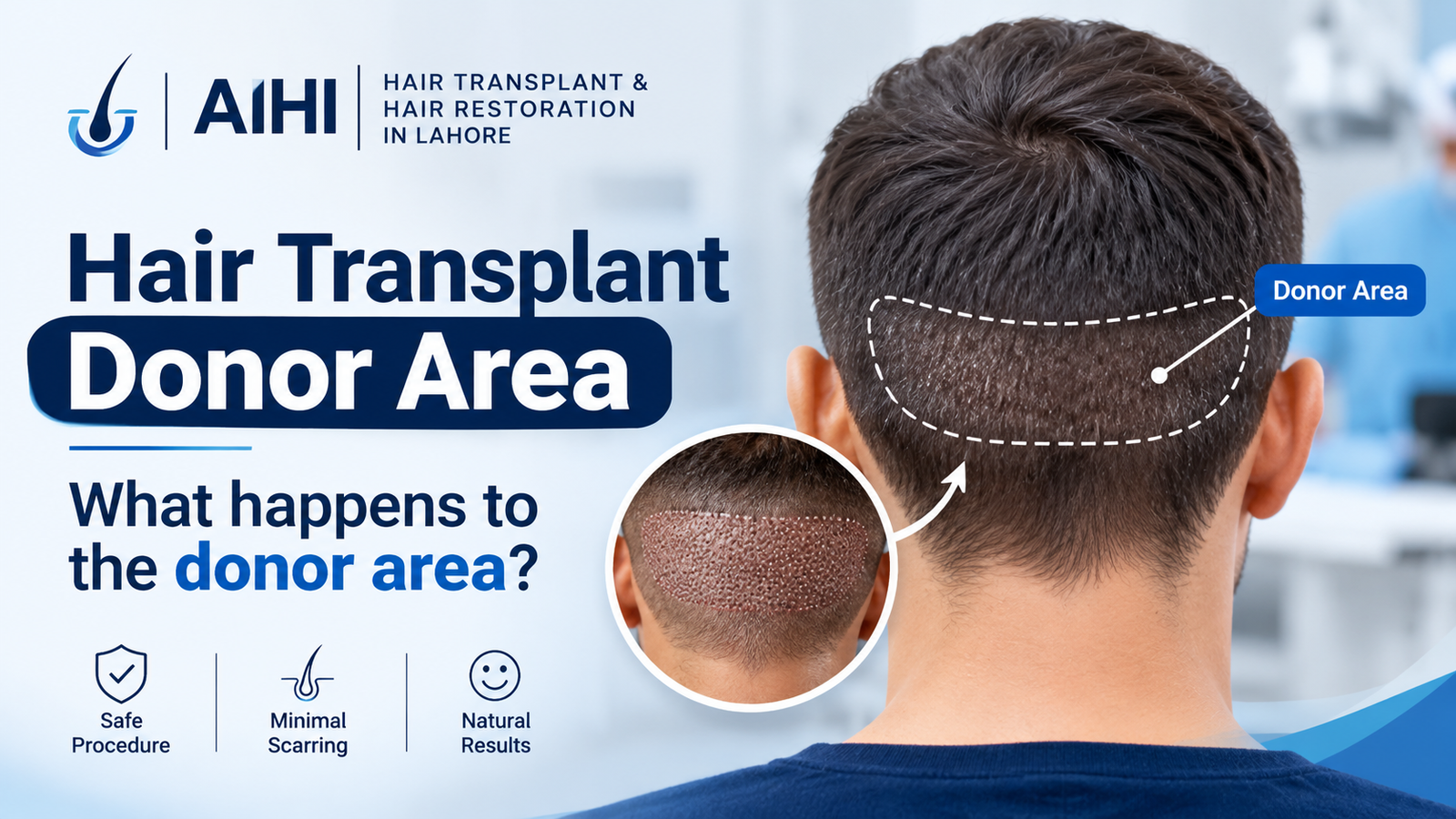
The donor area is the permanent zone at the back and sides of your scalp — roughly from one ear, around the back of the head, to the other. Its follicles are genetically resistant to DHT, the hormone that causes pattern baldness, which is why transplanted hair keeps growing for life in its new position.
Before surgery, your surgeon examines this zone with trichoscopy to measure its density and work out how many grafts it can safely give. That number is your lifetime donor supply — limited, which is why a good surgeon never takes more than the area can spare.
What Happens to the Hair Transplant Donor Area During Surgery?
It depends on the technique:
FUE (Follicular Unit Extraction): The surgeon removes individual follicular units one by one with a micro-punch tool as small as 0.6–0.9 mm. Each extraction leaves a tiny dot-shaped wound that closes on its own — no stitches, no linear scar. Extractions are spread evenly so no single spot looks thin.
FUT (Follicular Unit Transplantation): A narrow strip of scalp is removed and the wound closed with sutures, using a trichophytic closure that lets hair grow through the scar line. It gives the highest yield in one session — 3,000–5,000+ grafts — but leaves a fine linear scar, concealed by surrounding hair.
DHI (Direct Hair Implantation): Extraction is the same as FUE, so the donor area is affected in exactly the same way — only implantation differs.
Donor Area Healing Timeline
Healing follows a predictable pattern:
- Days 1–3: The donor area looks red and tender, with tiny scabs over each extraction point. Sleep with your head elevated at 45° and avoid touching it.
- Days 4–7: Begin the gentle washing protocol — diluted shampoo, fingertip pads only, no rubbing. Scabs start to soften.
- Week 2: Most scabs have fallen off and redness is fading. You may notice short-term shedding around the donor zone — shock loss, covered below.
- Months 1–3: The donor area looks and feels normal again. Any shed hair is already regrowing.
- Months 6–12: Healing is complete. With FUE, the tiny dot scars have faded to the point where they are very difficult to see.
Does Hair Grow Back in the Donor Area?
The honest answer is: the extracted follicles themselves do not grow back — each graft is a follicle unit moved to a new home. But the donor area does not go bald, because the surgeon only removes a spread-out fraction of the follicles, and the remaining hair grows over the tiny gaps.
Over-harvesting is the one real risk: taking too many grafts too close together leaves visible thinning that cannot be fixed. It is the strongest reason to choose a surgeon who plans your donor supply carefully instead of promising the maximum graft count.
Donor Area Shock Loss: Is It Normal?
Yes. Two to six weeks after surgery, some existing hair around the extraction sites may shed. This is shock loss: surrounding follicles react to the trauma of surgery by entering the resting phase early. It looks alarming, but it is temporary — the shed hair regrows on its own, usually within three to four months — and it does not affect the transplanted grafts.
Will the Donor Area Scar?
Every hair transplant leaves some donor area scarring — the question is how visible it is.
In the FUE donor area, the scars are hundreds of tiny dots, each less than a millimetre wide. Once healed, they are usually invisible, even with short hair — although a zero-guard shave can sometimes show faint marks in bright light.
With FUT, the scar is a single fine line across the back of the head, easily hidden once the surrounding hair grows a few centimetres — but it will show if you shave the back of your head. How well any scar heals depends on the surgeon’s technique, the punch size, and your own skin.
How to Look After Your Donor Area After Surgery
Good aftercare makes a real difference:
- Washing: No water on the scalp for the first three days — use the saline mist spray provided. From day 4, wash gently with diluted mild shampoo and lukewarm water poured from a cup, never direct shower pressure.
- Touching: Never scratch, pick at scabs, or rub the donor area. Let crusts fall off naturally.
- Sleeping: Keep your head elevated at 45° for the first few nights to reduce swelling.
- Activity: Avoid sweating and strenuous exercise in the first days. No swimming in chlorinated pools for six weeks.
- Smoking and alcohol: Both slow healing. Avoid them for at least two weeks after surgery.
- Sun: Protect the donor area from direct sun for the first month — wear a loose hat outdoors.
How PRP Therapy Speeds Up Donor Area Recovery
Healing can be supported, not just waited out. Hair PRP Therapy at AIHI uses growth factors concentrated from your own blood to stimulate repair in the hair transplant donor area — improving blood flow to the extraction sites, calming inflammation, and helping surrounding hair regrow faster after shock loss. Because it comes from your own blood, there is no rejection risk.
PRP is a standard part of the post-transplant plan at AIHI, starting with an early session around the first follow-up visit. If you are planning a transplant, ask about adding PRP to your plan — it supports both the donor area and the new grafts.
When to Contact Your Clinic
Mild redness, tenderness and itching are normal. Contact your clinic promptly if you notice increasing pain or swelling after day 3, pus or discharge, a fever, or heavy bleeding. At AIHI, the nursing team is on WhatsApp 24/7 for the first two weeks after your transplant — never hesitate to send a photo and ask.
Frequently Asked Questions
How long does donor area pain last?
Most patients feel mild soreness for two to four days, easily managed with the prescribed pain relief. The donor area usually feels normal again within a week.
Can I cut my hair short after FUE?
Yes — in most cases the dot scars are invisible at short lengths. If you plan a very close shave, discuss it with your surgeon beforehand.
Ready to find out what your donor area can do? Book a free consultation at Aesthetic Intelligence Hair Institute in Lahore — your surgeon will assess your donor supply with trichoscopy and give you an honest plan. Book your free consultation on WhatsApp.
